

Bank of Canada Holds at 2.25%: What It Means for Your Mortgage in 2026 and 2027
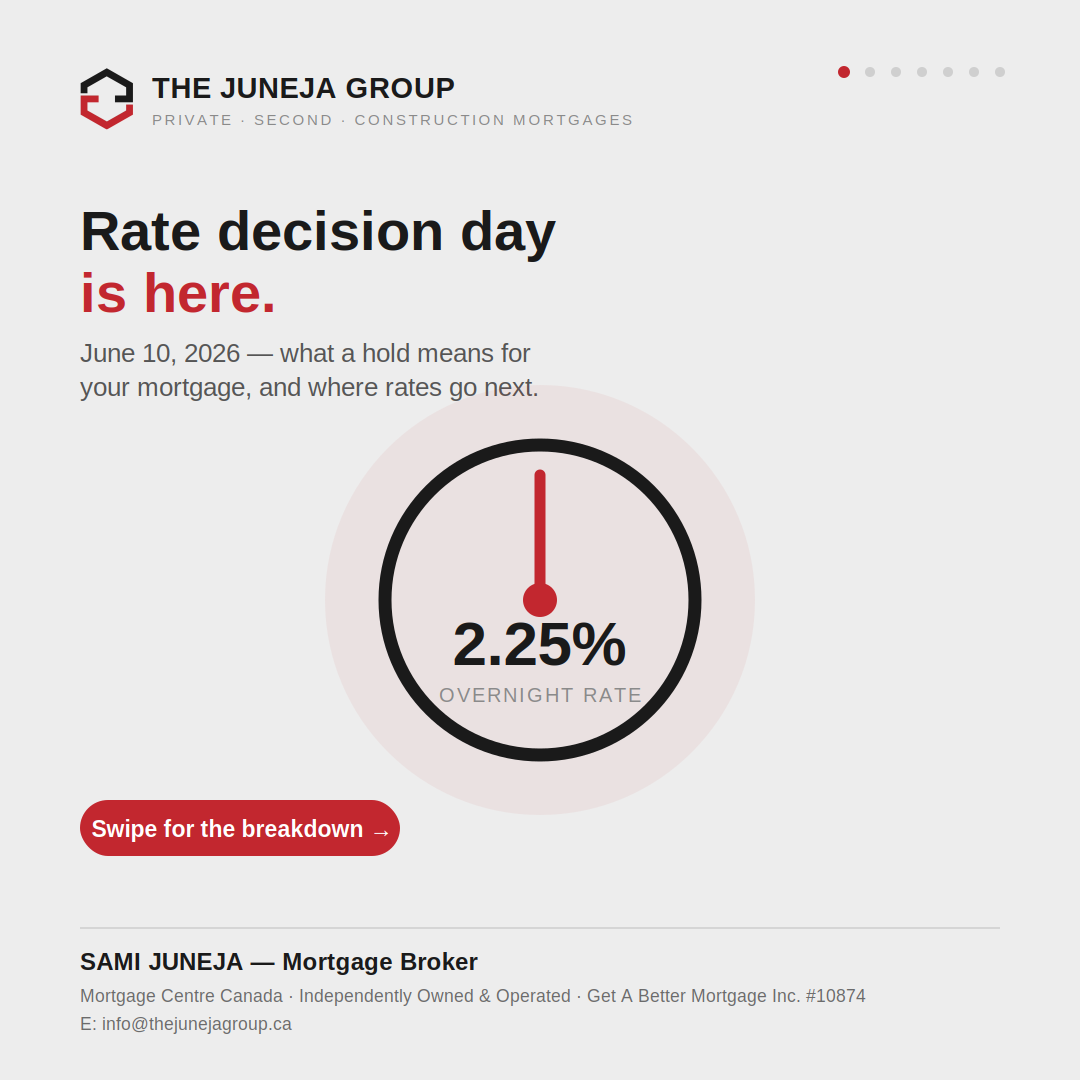
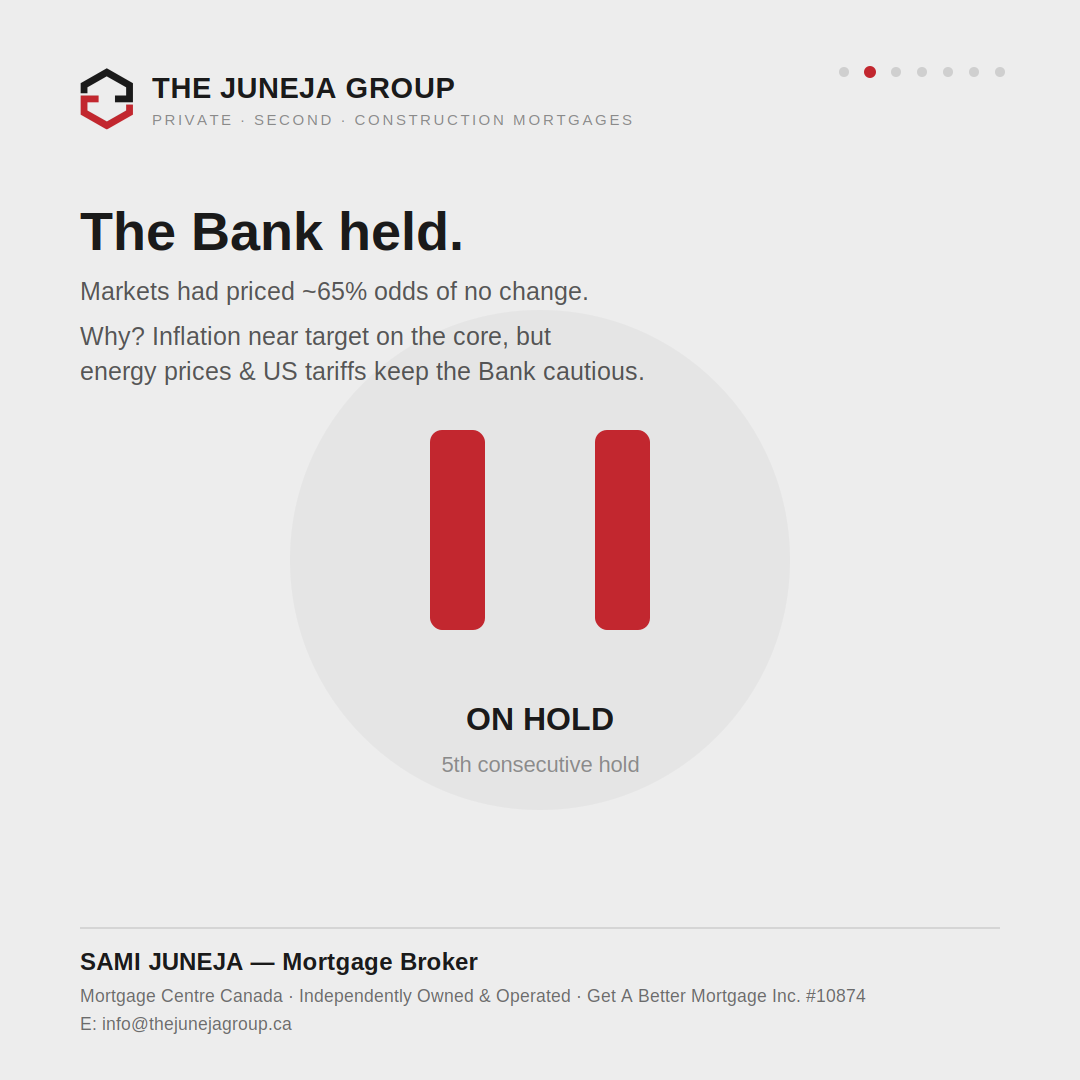
On June 10, 2026, the Bank of Canada held the overnight rate at 2.25% — the fifth consecutive hold. Here's why the Bank is holding, why fixed rates move on a different engine, and where the Big 6 banks see the policy rate by the end of 2027.
By Sami Juneja, Mortgage Broker · The Juneja Group
The story in 7 slides

Swipe or use the arrows to step through the deck.
Why the Bank is holding
The Bank of Canada is caught between two opposing forces.
On one side, core inflation — the underlying measure that strips out volatile items — has been sitting close to the Bank's 2% target. That alone would give the Bank room to consider cutting.
On the other side, headline inflation has been pushed up by energy prices, driven largely by Middle East conflict and its effect on oil, alongside the ongoing drag from U.S. tariffs on Canadian trade. The Bank has signalled it is reluctant to react to energy-driven inflation if it proves temporary, but it also can't ignore the risk that those pressures stick around.
The result is a holding pattern. The Bank itself projects inflation easing back toward 2% by early 2027, but it has been explicit that uncertainty is high and that it is prepared to move in either direction if the outlook shifts.
Variable vs. the bond market: different engines
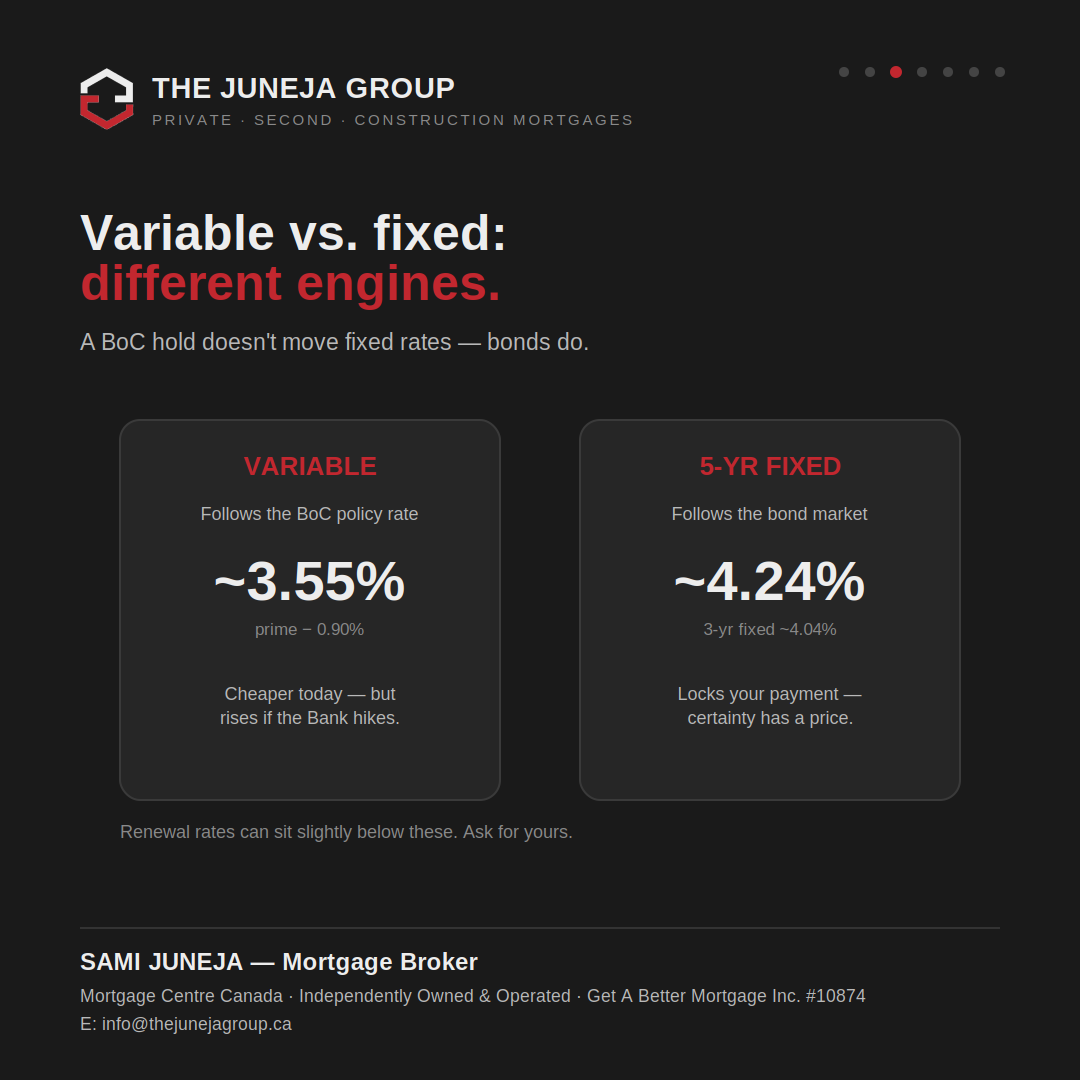
This is where most borrowers get tripped up. Variable and fixed rates are priced off entirely different things.
Cheaper today — but rises (usually within days) if the Bank hikes.
Locks your payment — certainty has a price.
Fixed mortgages are priced off the Government of Canada 5-year bond yield (currently ~3.1%) plus a lender spread of roughly 1–2%. The key takeaway that surprises people: a Bank of Canada hold does not directly move fixed rates. Fixed rates can rise even when the Bank sits still if bond yields climb on inflation fears, and can fall without a cut if yields drop. Renewal rates can sit slightly below these — always ask what you specifically qualify for.
Rest of 2026: stable, with a slight upward tilt
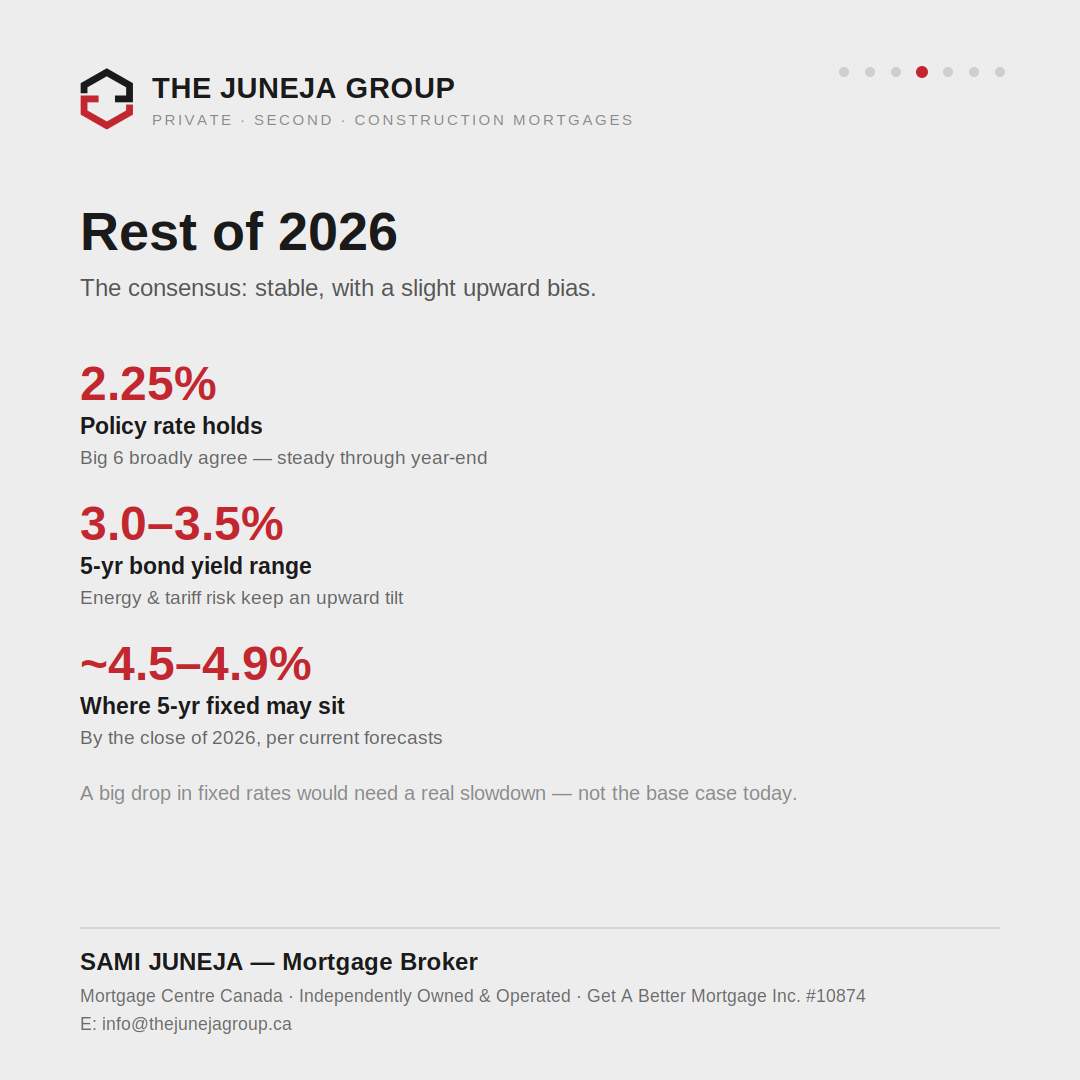
The consensus among Canada's major bank economists for the remainder of 2026:
Big 6 broadly agree — steady through year-end.
Energy & tariff risk keep an upward tilt.
By close of 2026, per current forecasts.
A meaningful drop in fixed rates would require a confirmed economic slowdown and a fall in oil prices — neither is the base case today.
2027: where the banks stop agreeing
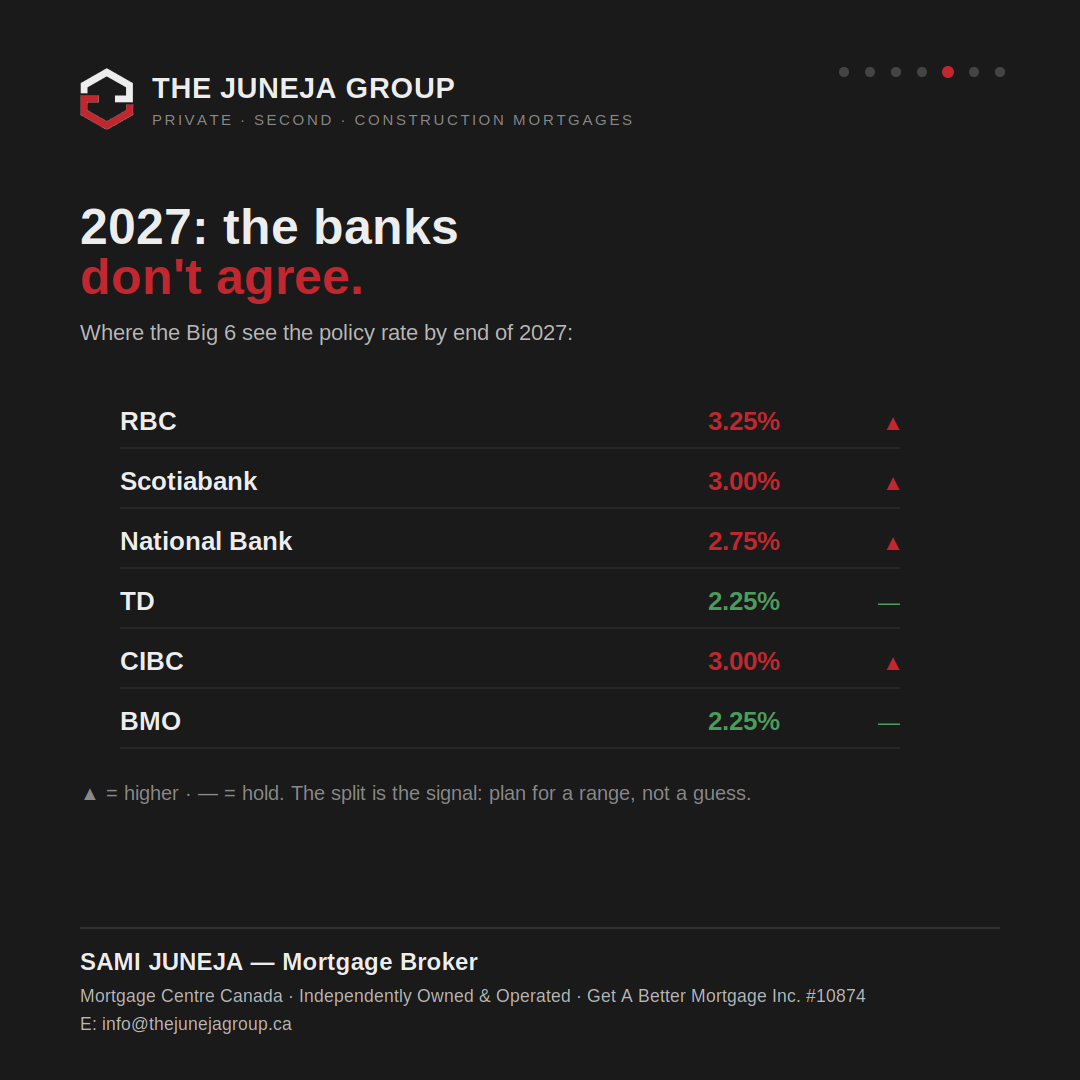
For 2026, the Big 6 banks largely agree. For 2027, they split sharply. Here's where each sees the policy rate landing by the end of 2027:
| Bank | End-of-2027 policy rate | Direction |
|---|---|---|
| RBC | 3.25% | Higher |
| Scotiabank | 3.00% | Higher |
| CIBC | 3.00% | Higher |
| National Bank | 2.75% | Higher |
| TD | 2.25% | Hold |
| BMO | 2.25% | Hold |
Roughly half the major banks expect the Bank of Canada to begin raising rates as the economy firms up; the other half expect a prolonged hold. The honest interpretation: nobody knows. When the country's best-resourced economists disagree by a full percentage point, that disagreement is itself the signal. Build a mortgage plan that holds up across the range.
What this means for you
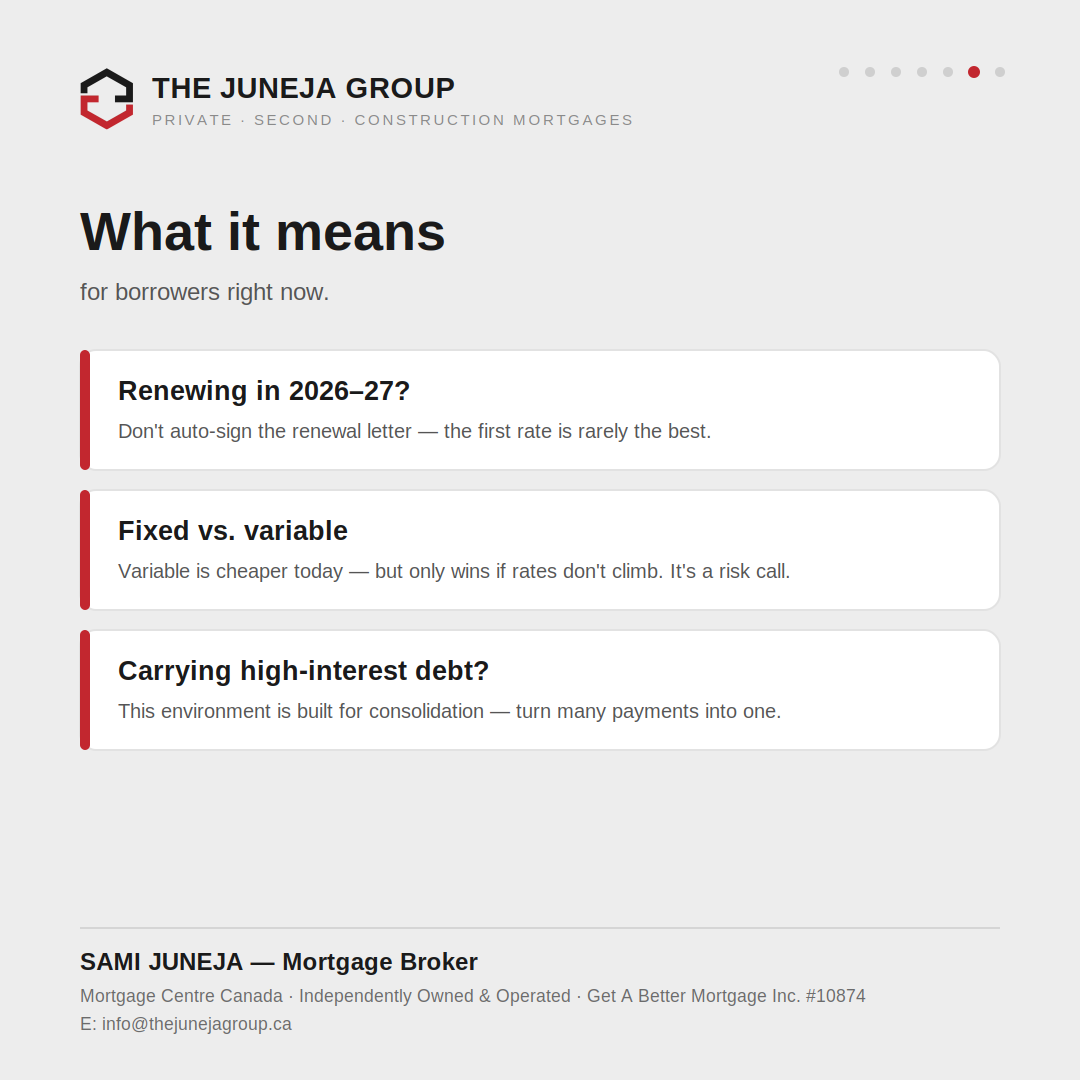
Renewing in 2026 or 2027?
You're in a far better position than borrowers who renewed at the 2023–2024 peak. But don't simply sign the renewal letter your lender mails you — the rate on that letter is almost never their best offer. Shop it, or have a broker shop it for you.
Weighing fixed vs. variable?
Variable (~3.55%) is meaningfully cheaper than 5-year fixed (~4.24%) — a gap of roughly 0.7%. But that gap is a bet, not a free lunch. Variable only wins if the Bank holds or cuts over your term. A shorter fixed term (2 or 3 years) can be a sensible middle path if you'd rather not gamble but don't want to lock in for five.
Carrying high-interest debt, tax debt, or CRA arrears?
A stable-rate environment is a reasonable time to consolidate. Rolling multiple high-interest balances into one mortgage payment — through a refinance or a second mortgage — can lower your overall interest costs and free up monthly cash flow.
Don't guess the rate. Get advice.
Renewal, refinance, or debt consolidation — we'll match options to your actual situation. Send us your goal, the amount you need, and your property's estimated value. We respond the same business day.
Educational content only.
Rate data is current as of June 8–10, 2026 and is subject to change. Forecasts reflect published outlooks from Canada's major bank economists and are not guarantees. The Juneja Group — Sami Juneja, Mortgage Broker · Get A Better Mortgage Inc. (Lic. #10874), independently owned and operated office of Mortgage Centre Canada. Consult a licensed mortgage professional for advice specific to your situation.
Related guide
Mortgage Renewal 2026: Rates, Traps & Negotiation Strategy
Holding rates changes the math on renewals — see the full 2026 renewal strategy guide.
Educational information only — subject to approval
This website provides general educational information only and does not constitute financial, mortgage, legal, or tax advice. All rates, products, scenarios, and calculator results are illustrative and subject to lender approval, credit qualification, property valuation, and current market conditions. Mortgages are arranged by Saminder Juneja, Mortgage Broker — Mortgage Centre Canada / Get A Better Mortgage Inc. (FSRA #10874). Nothing on this site constitutes an offer to lend.