
If you're planning to finance, refinance, or acquire commercial real estate in Canada this year, the terms lenders are actually offering right now matter more than the terms they were offering six months ago. Every quarter, Avison Young surveys the debt capital markets and publishes first-mortgage lending conditions across the four major property types. We pulled the Q2 2026 numbers apart to show you what's changed, where the opportunities are, and where lenders are still cautious.
Here's the short version: debt capital remains available across every major asset class, but pricing and leverage are diverging sharply by property type. Industrial borrowers are getting the best pricing of the cycle. Office borrowers are still working through the tightest terms. Multifamily is a story of two programs — conventional and CMHC MLI — that increasingly don't look like the same market at all.
The four asset classes at a glance
Before we go property-type by property-type, here's the full picture in one view — maximum loan-to-value, the spread lenders are charging over the 5-year Government of Canada bond yield, and where each sector's outlook is headed next quarter.
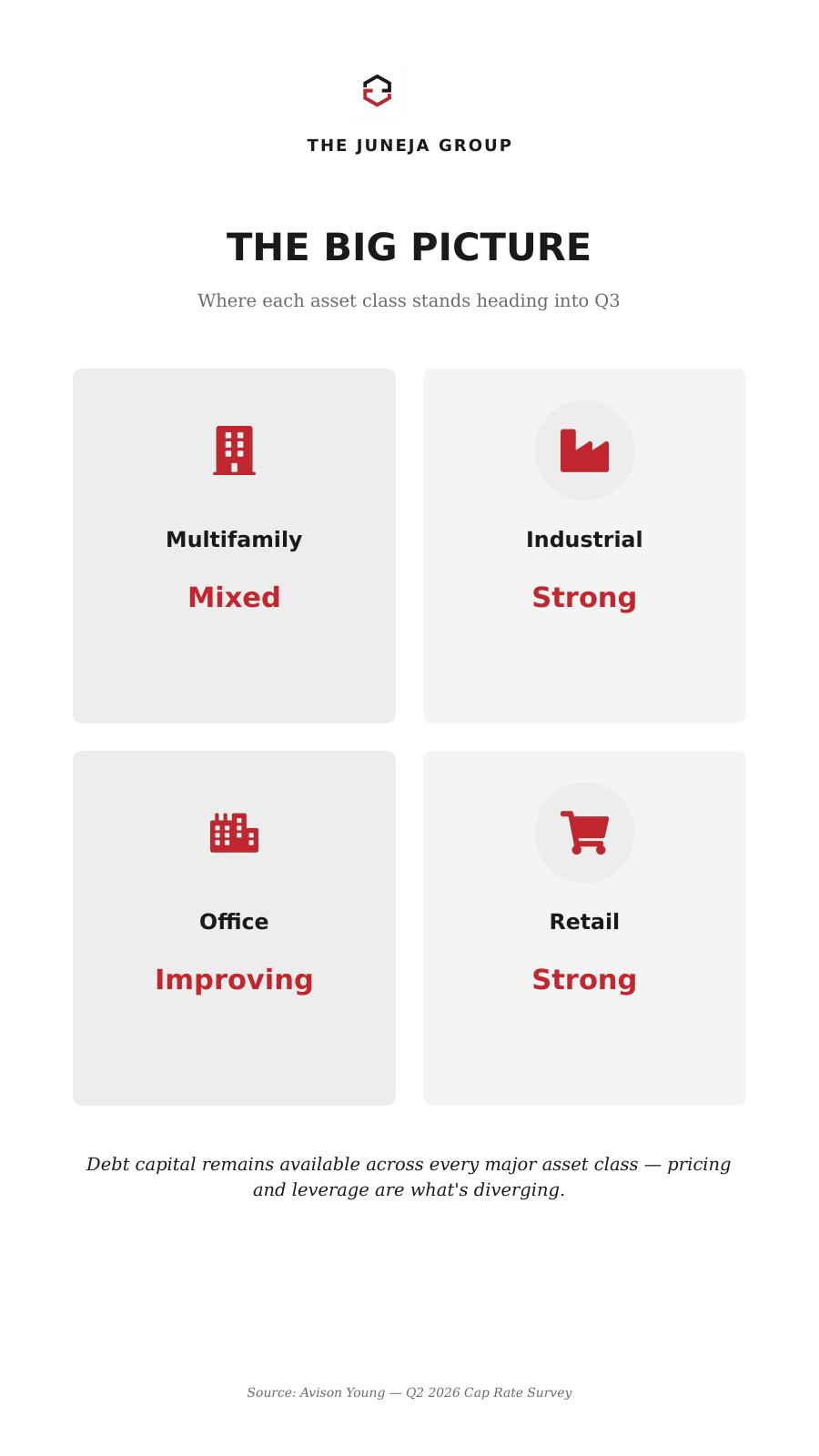
A few things jump out immediately. Office remains the most conservative box — 65% maximum LTV, the widest spread on the table, and the shortest amortization. Industrial, by contrast, is being priced almost as favorably as conventional multifamily, with lenders competing hard for well-located, income-producing assets. Retail continues to be the quiet performer of the group: strong outlook, competitive pricing, and comparatively little attention in the broader financing conversation.
Multifamily: the most flexible box in the market — if you qualify
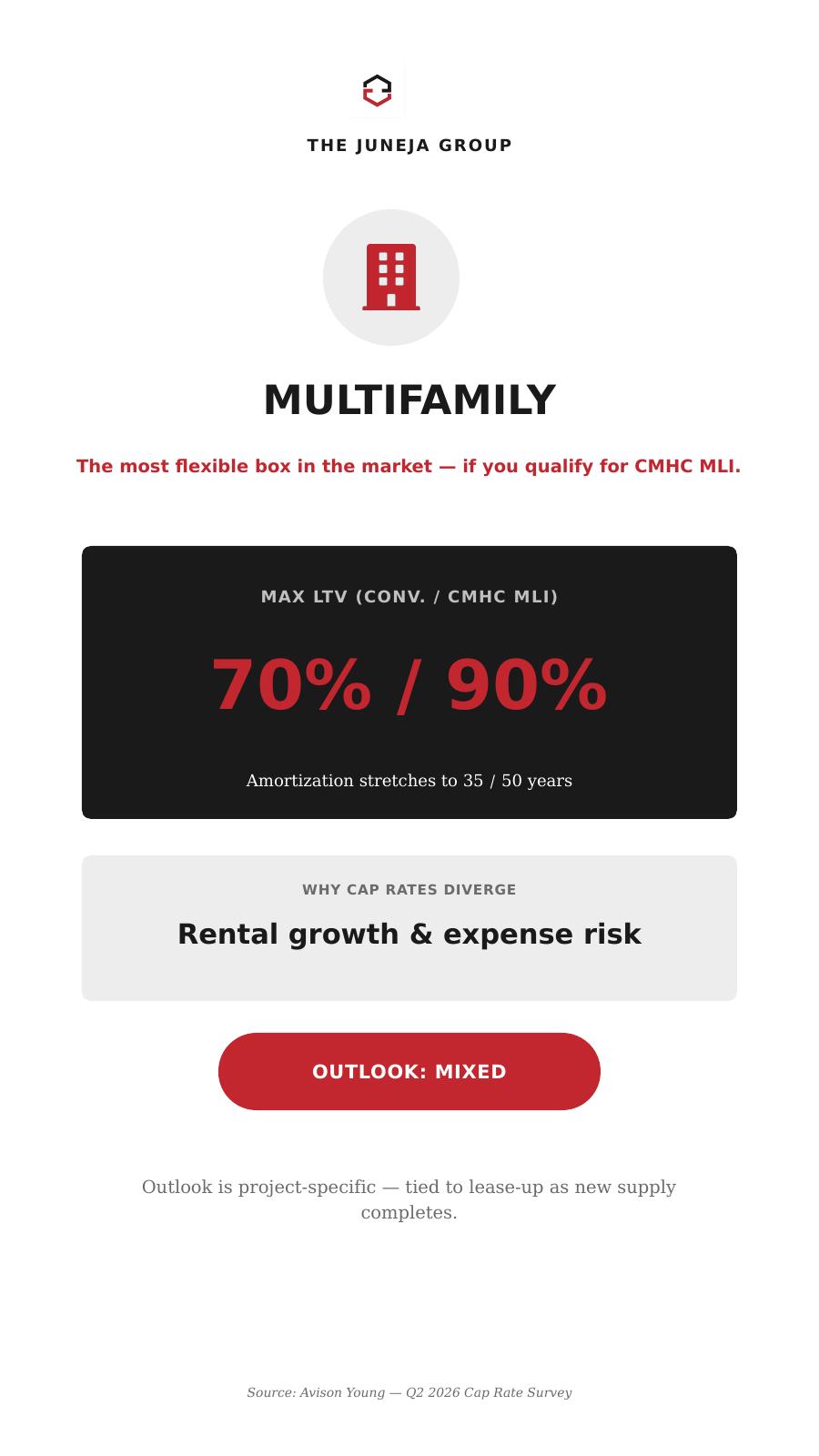
Multifamily is really two markets living under one label. Conventional financing tops out at 70% LTV with a 35-year amortization; CMHC MLI-insured financing can reach 90% LTV and stretch to 50 years. That gap is the single biggest lever available to multifamily sponsors right now, and it's why so much of the current deal flow in the space is being structured specifically to qualify for MLI.
The reason underwriters apply a premium to appraised cap rates here comes down to two things: the risk in actually achieving underwritten rental-rate growth, and rising operating expenses. Loan application volume is up on the conventional side and down on the CMHC side — worth watching if you're timing an application. Both arrears and defaults are only slightly elevated. Overall outlook: it's genuinely project-specific, tied closely to lease-up performance as new supply comes online.
Industrial: the cheapest non-recourse pricing this quarter
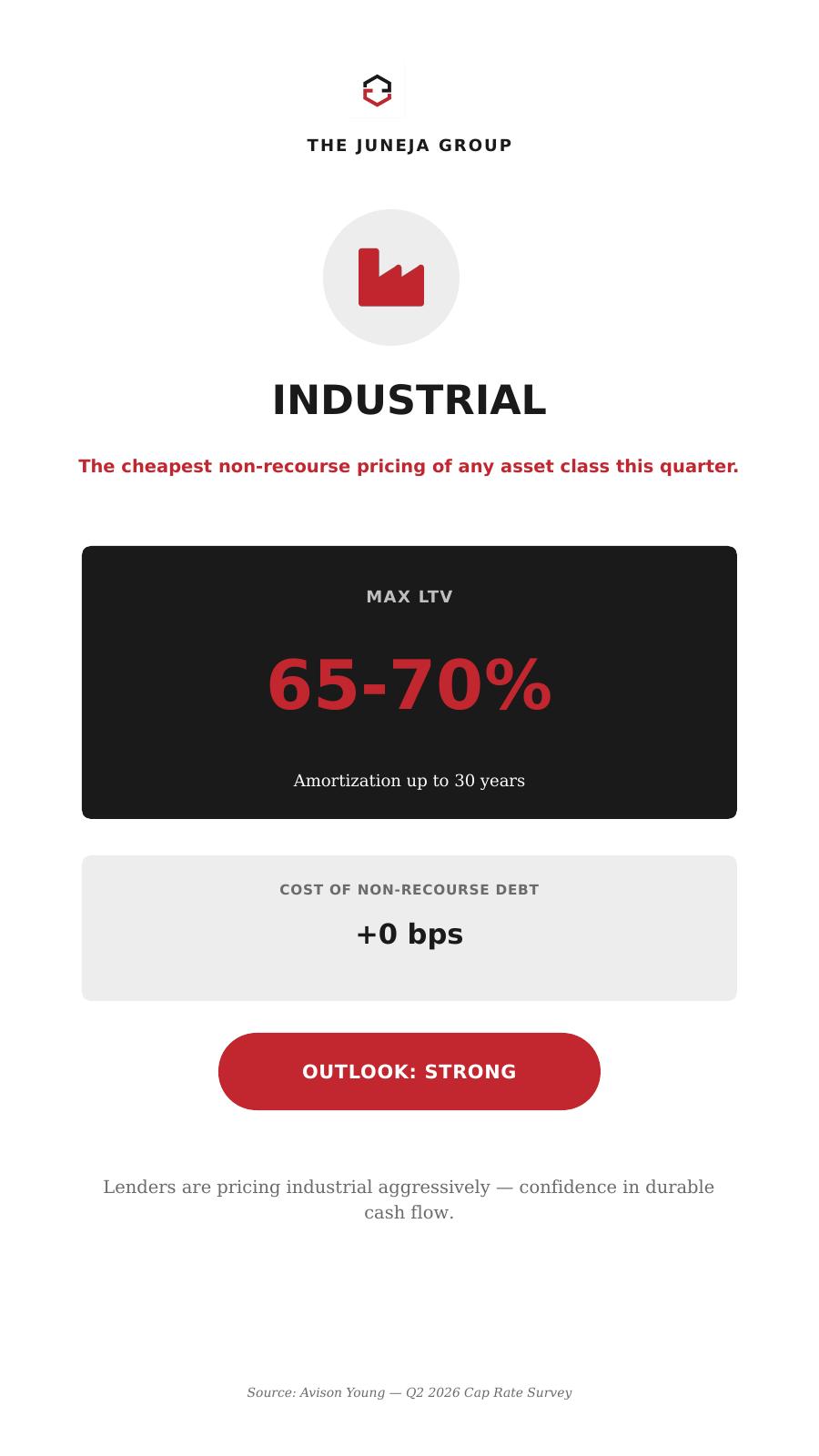
Industrial is where lenders are being most aggressive. At 65–70% LTV and a 25–30 year amortization, the leverage isn't dramatically different from other asset classes — but the pricing is. The cost of non-recourse debt for industrial is effectively at par this quarter, the tightest of any property type. Loan applications are stable, arrears are only slightly up (and regionally concentrated), and the sector's outlook remains strong. If you're holding or acquiring industrial product, this is a genuinely good quarter to be talking to your lender.
Office: tightest leverage, widest spreads — but the direction is changing
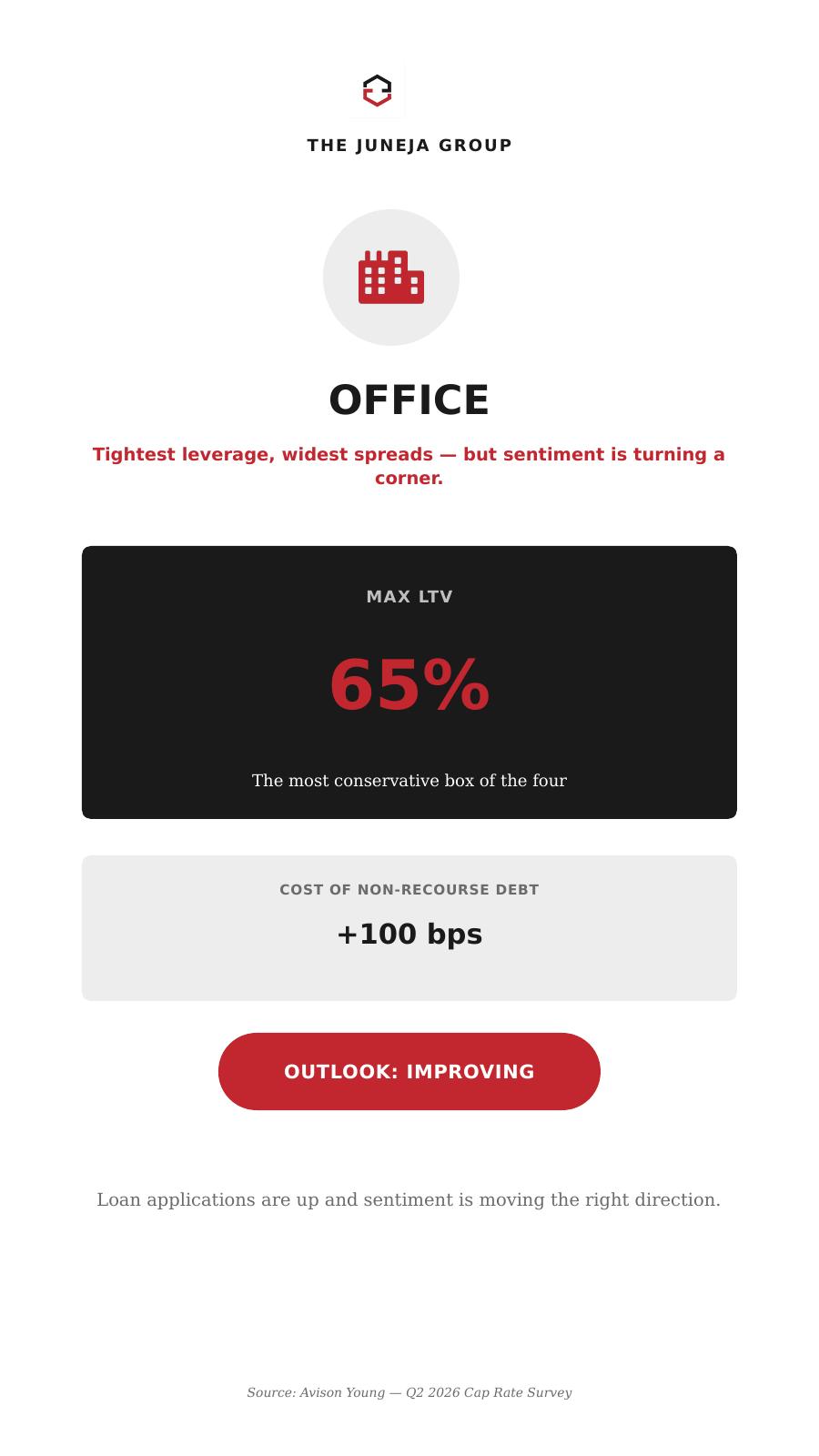
Office continues to carry the most conservative terms of the four: 65% maximum LTV, a 25-year amortization ceiling, and the widest spread over the 5-year GoC bond — 200 to 250 basis points. Non-recourse debt here costs a full 100 basis points more than industrial. Vacancy remains the primary reason underwriters discount appraised cap rates when pricing office debt.
The more interesting signal is the direction of travel: loan applications are up, arrears and defaults are stable, and the sector's outlook has moved from "cautious" to "improving." Office isn't back to where it was, but the trend line for well-positioned assets is moving the right way.
Retail: steady, well-priced, and overlooked

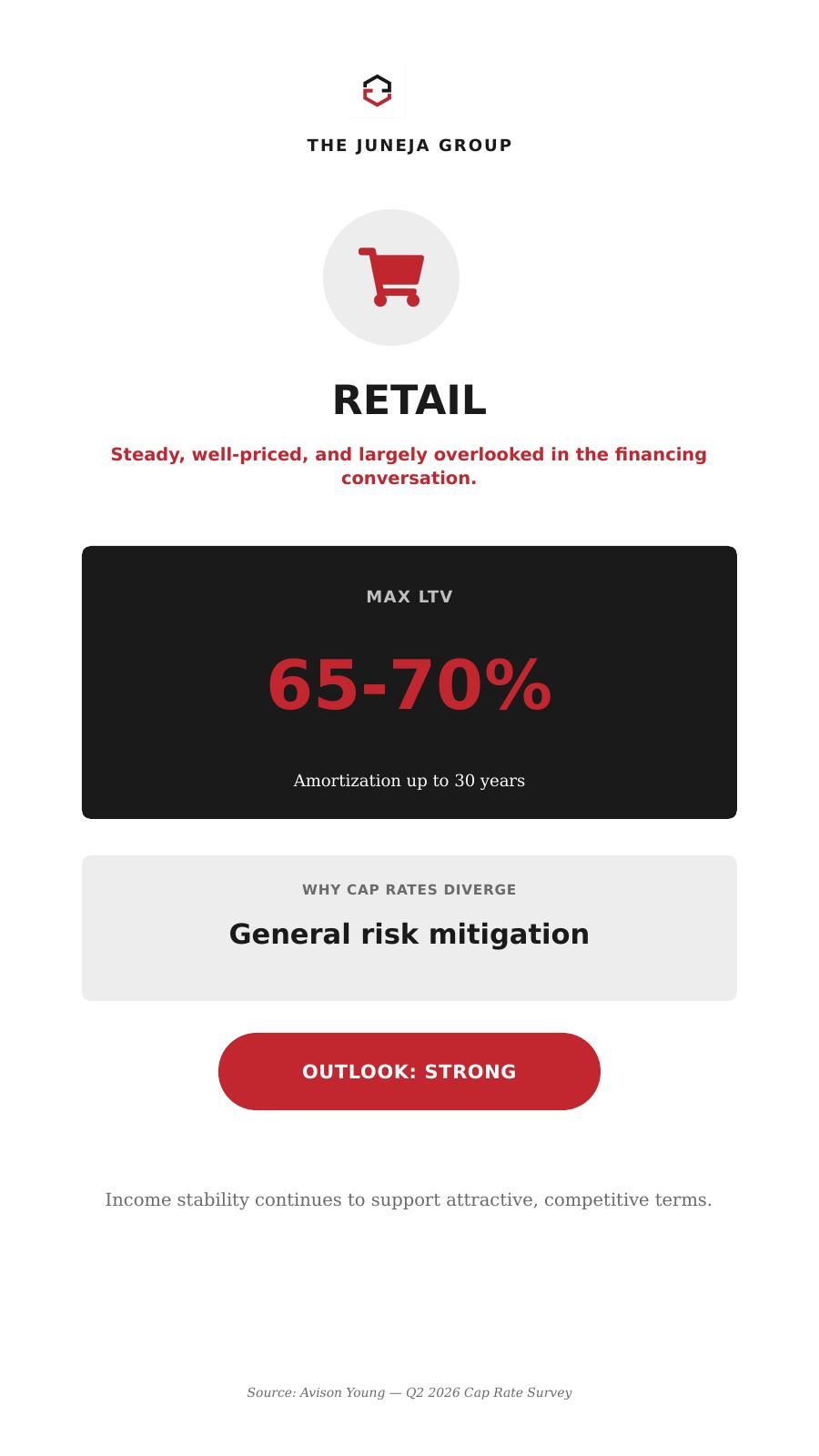
Retail rarely gets the attention that multifamily or industrial does in financing conversations, but the numbers this quarter make a case for paying more attention. LTV sits at 65–70%, amortization runs 25–30 years, and pricing is competitive with industrial. The premium lenders apply to appraised cap rates here isn't driven by any single tenant or category risk — it's general risk mitigation, which is a sign of a market lenders consider fundamentally stable. Loan applications are slightly up, arrears and defaults are flat, and the outlook is strong.
What this means if you're financing a deal this quarter
Debt capital is available — that's the headline from Avison Young's Q2 2026 survey. But "available" doesn't mean "priced the same everywhere." The spread between the cheapest debt on the table (industrial, near-par non-recourse pricing) and the most expensive (office, +100 bps) is wide enough that asset selection and structuring now matter as much as timing.
For sponsors and investors weighing their next move, the practical questions are:
- Does your multifamily deal actually qualify for CMHC MLI, and is it worth restructuring to get there?
- Is your industrial asset positioned to capture the best non-recourse pricing available this cycle?
- If you're holding office, what specific factors are driving your appraisal-to-underwriting gap — and can they be addressed before you go to market?
- Is your retail asset getting a fair look, or is it being priced on outdated assumptions about the sector?
These aren't questions with generic answers. They depend on the specific asset, sponsor, and lender relationship — which is exactly where working with a mortgage broker who tracks these numbers every quarter pays off.
Data source: Avison Young, Q2 2026 Cap Rate Survey — Canadian Cap Rate & Investment Trends.